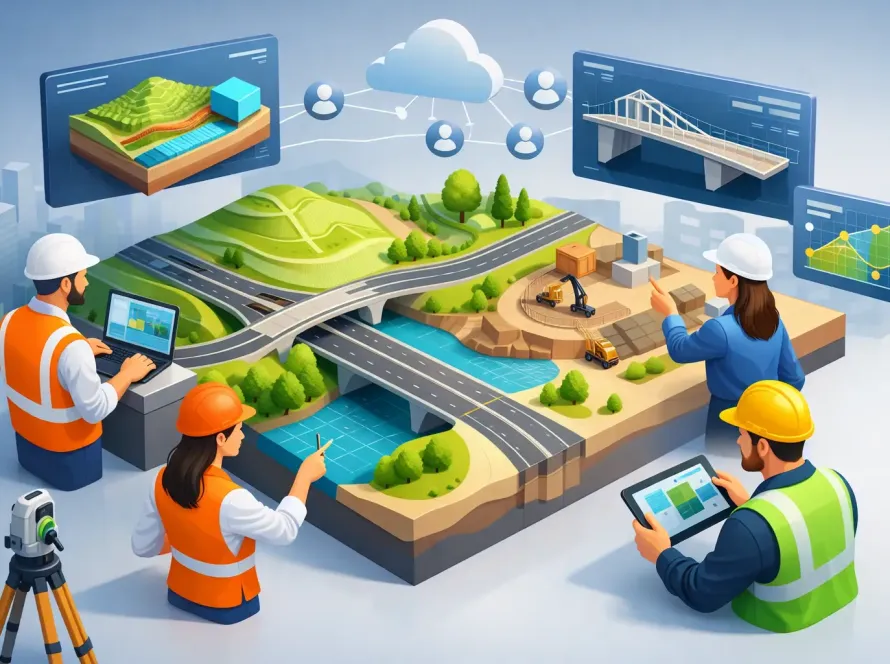
A superintendent opens one dashboard and sees the latest model issue, an RFI trend, field progress, a cost variance, and a handoff risk before the weekly meeting starts. That is the practical shape of the future of construction data platforms. Not another place to store files, but a system that turns project information into coordinated action.
For AEC teams, this shift is overdue. Most firms still operate across disconnected clouds, discipline-specific tools, spreadsheets, email threads, and local folders that only make sense to the people who built them. Data exists everywhere, but useful project intelligence is still hard to access at the right moment. The next generation of platforms is being defined by one core expectation: construction data should move with the workflow, not fight it.
What the future of construction data platforms really looks like
The market is moving past simple document management. The future of construction data platforms is centered on context, interoperability, and decision support. That means a platform needs to understand what a file is, where it belongs in the lifecycle, who needs it, and what should happen next.
In practical terms, teams are no longer satisfied with uploading models, drawings, and reports into separate systems and calling that digital transformation. They want connections between BIM authoring tools, field activity, business operations, and client-facing deliverables. A change in a model should not stay trapped in the model. It should cascade into coordination, scheduling, communication, and risk tracking with as little manual intervention as possible.
This is where platform strategy starts to matter more than point software. A plugin can speed up one task. A true data platform can reduce friction across design, preconstruction, construction, and operations. For firms trying to scale standards across regions, project types, or business units, that difference is major.
From file repositories to living project systems
For years, many construction platforms functioned as digital filing cabinets with permission controls. That solved one problem, but not the bigger one. Teams still had to interpret scattered information manually and reconcile contradictions after the fact.
The next wave is different. Data platforms are becoming living project systems that combine model intelligence, communications, status tracking, analytics, and operational records in one environment. Instead of asking, Where is the latest file, teams increasingly ask, What is the current project condition?
That distinction changes everything. A current project condition includes model version history, issue resolution progress, field observations, procurement status, and the business signals around delivery performance. When that information is connected, the platform becomes more than infrastructure. It becomes a working layer for execution.
There is a trade-off, though. More connected systems require stronger governance. If naming conventions, metadata standards, permissions, and integration logic are weak, the platform can spread confusion faster than email ever did. The firms that benefit most will be the ones that treat data structure as part of project delivery, not an afterthought.
Interoperability will decide who wins
Construction technology is not heading toward a one-vendor reality. Most firms rely on a stack that includes Autodesk products, analysis tools, visualization tools, communication systems, estimating workflows, and internal business software. That stack is not going away.
So the future belongs to platforms that can operate inside mixed environments without breaking process continuity. Interoperability is no longer a technical bonus. It is a commercial requirement. If a platform cannot work across Revit, AutoCAD, Civil 3D, Advanced Steel, SketchUp, field data, CRM records, and reporting layers, it creates another silo instead of solving one.
This is especially true for firms that serve multiple delivery models. A design firm needs one kind of visibility. A contractor needs another. An owner wants yet another view focused on risk, milestones, and long-term asset value. A modern construction data platform has to support all three without forcing duplicate data entry everywhere.
The challenge is that integration alone is not enough. Plenty of systems connect on paper but fail in practice because the data arrives out of sync, stripped of context, or locked in a rigid schema. The strongest platforms will not just pass data through APIs. They will preserve meaning across workflows.
AI will amplify platform value, but only if the data is usable
AI is already influencing expectations in construction. Teams want help spotting clashes earlier, predicting schedule pressure, surfacing submittal bottlenecks, and identifying quality risks before they become claims. That promise is real, but it depends on the maturity of the underlying platform.
AI does not fix bad data foundations. If project records are inconsistent, unstructured, and split across disconnected systems, machine learning outputs will be noisy at best and misleading at worst. That is why the future of construction data platforms is tightly tied to structured data, standardized metadata, and traceable histories.
The near-term opportunity is less about flashy automation and more about practical intelligence. Think issue prioritization, anomaly detection, smart search across technical and operational content, and role-based recommendations. These functions can save real hours and reduce avoidable mistakes. Over time, more predictive capabilities will become useful, but only when firms trust the platform’s data layer.
For leaders evaluating platform direction, the question is not whether AI belongs in construction systems. It does. The better question is whether the platform is building the conditions that make AI reliable.
Security, access, and trust will move to the center
As project ecosystems become more connected, security stops being an IT side topic. Construction data platforms increasingly hold design intelligence, financial signals, client communications, field records, and operational documentation. That creates value, but it also raises the stakes.
Future-ready platforms will be judged by how well they handle role-based access, secure file transfer, audit trails, external collaboration, and data residency requirements when needed. For enterprise AEC teams, this matters just as much as user experience.
There is also a trust issue inside firms. Teams adopt platforms faster when they believe the information is current, permissions are clear, and workflows are stable. If users worry that data is stale or exposed to the wrong audience, they revert to offline habits. That is why trust architecture matters. Good platforms reduce ambiguity, not just complexity.
Digital twins and lifecycle continuity will expand the platform role
One of the biggest changes ahead is that construction data platforms will not end at substantial completion. The handoff between design, construction, and operations has been weak for decades because data gets flattened during transition. Models lose relevance, issue history disappears, and facilities teams receive information they cannot easily use.
That model is changing. As digital twins become more practical, platforms will increasingly carry forward structured project intelligence into operations. This does not mean every project needs a fully immersive twin on day one. It means the data environment should be capable of supporting lifecycle visibility when the owner needs it.
That has implications upstream. If a team knows project data may support maintenance, sustainability tracking, space management, or future renovations, they will structure information differently from the beginning. The platform becomes a long-term asset layer, not just a delivery tool.
The firms that move first will operate differently
The real advantage of better construction data platforms is not cleaner dashboards. It is organizational speed. Firms with connected systems can standardize workflows faster, onboard teams with less friction, measure performance across projects, and respond to problems before they spread.
This is where ecosystem thinking starts to outperform isolated software decisions. AEC companies need platforms that support modeling, collaboration, analytics, secure communication, and business operations in one connected framework. That is the direction the market is heading because fragmented workflows are too expensive to maintain.
For teams already feeling the drag of duplicate entry, scattered approvals, and limited visibility, this is not a distant trend. It is an active operating decision. Build a platform strategy now, or keep paying for fragmentation later.
BIMeta reflects this shift by treating the platform as a connected AEC environment rather than a single-purpose tool, linking BIM workflows with collaboration, analytics, file control, digital twin capabilities, and business infrastructure built for scale.
The future of construction data platforms will belong to firms that treat information as an active system, not archived output. The smartest next step is usually not adding another app. It is choosing a platform approach that gives every model, file, workflow, and decision a shared operational context.